
Prize Money Over Welfare? The Deaf Horse Debate
Breeding deaf horses is widely regarded by equine welfare advocates and many breeders as irresponsible, as deafness is a significant disability in a prey animal that relies heavily on sound for communication, awareness, and safety. Knowingly breeding horses with congenital disabilities risks perpetuating those defects through future generations and raises serious ethical concerns within the industry.
Critics argue that sections of the National Reining Horse Association (NRHA) breeding community have continued to expand bloodlines associated with congenital deafness with little regard for long-term animal welfare. Questions are increasingly being asked: is the continued promotion of these bloodlines driven purely by prize money and commercial success, or are trainers benefiting from horses that may be more prone to learned helplessness due to their disability?
As one respected breeder reportedly stated, “Of all the great horses to promote, they pick a deaf one? The horse should have been gelded, and the mare pastured alone, no matter what they won.”
For many traditional breeders and horsemen, the responsibility of breeding extends beyond competition success. The role of a custodian of a breed is to strengthen bloodlines, improve soundness, and reduce inherited defects — not normalize them for financial gain. Increasing levels of line breeding and inbreeding within these bloodlines are now raising concerns about a growing concentration of genetic issues in future generations.
In summary, deliberately breeding horses known to carry congenital deafness is viewed by many as reckless. It places genetically disadvantaged animals into environments where hearing is essential for safety, communication, and long-term welfare.
The Retired Deaf Horse
Concerns also extend beyond breeding and into the long-term welfare of retired reining horses. With the NRHA’s heavy focus on prize money and performance, critics argue that the industry produces high levels of wastage, with many horses discarded once they no longer perform competitively.
For deaf horses, retirement can be particularly difficult. Unable to rely on auditory cues, they often become highly dependent on herd dynamics for security. In open pasture situations they may be vulnerable, anxious, or unpredictable, particularly around inexperienced handlers or riders outside controlled arena environments.
Many horses that fail to succeed in the reining pen face uncertain futures. Some are euthanized because of the ongoing management required, while others struggle with behavioural instability and fear-related responses linked to their disability.
Training the Deaf Horse
Leading Reining Horse Trainer Matt Mills explains the approach to training a deaf horse.
Identifying Traits Associated with Deafness
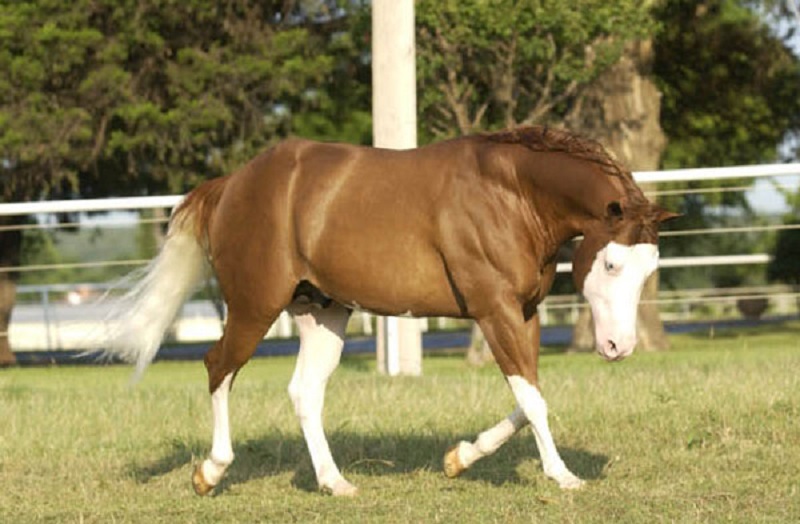
Congenital deafness in horses has frequently been associated with excessive white coat patterns, blue eyes, and bald facial markings. These traits are commonly linked to “splashed white” genetics and other pigment-related mutations connected to hearing loss.
Because of these concerns, organizations such as the American Quarter Horse Association and the American Paint Horse Association should be implementing breeding regulations relating to specific genetic conditions in an effort to protect the long-term health of the breed. Instead the American Quarter Horse Association (AQHA) set aside their rules to register “Gunner” that failed to meet regulations for allowable white markings and ignored the known fact he was Deaf.
Where the “Deaf Horse” Bloodline Began
Colonels Smoking Gun (1993–2013), widely known as “Gunner,” is commonly identified as the stallion most responsible for propagating the specific form of congenital deafness associated with excessive white markings within modern reining bloodlines.
Although deaf horses existed previously in the broader Quarter Horse and Paint Horse industries through unrelated genetic causes, Gunner became the defining carrier of this particular trait in elite reining pedigrees. Many of his descendants inherited both the characteristic white markings and, in some cases, deafness itself.
Key Facts About Gunner and Deafness
Gunner was born deaf, yet still became an exceptionally successful performance horse and sire. His distinctive appearance — a bald face, bright blue eyes, and loud white markings — became iconic within the reining industry.
Research has linked the condition to the Splashed White 2 (SW2) gene, which traces through his dam, Katie Gun. The mutation affects pigment development and, in some horses, prevents the formation of critical hearing structures within the inner ear.
Despite his deafness, Gunner achieved major success as a Reining Futurity Reserve Champion and later became a multimillion-dollar sire. His career demonstrated that deafness did not necessarily prevent elite athletic performance. However, it also ensured the rapid spread of the gene throughout the industry.
Several of his offspring, including Colonels Lil Gun, inherited both his talent and his deafness.
Progeny and Industry Impact
Gunner sired nearly 1,500 foals, with more than 880 becoming money earners. Collectively, his offspring accumulated more than $15 million in lifetime earnings, making him one of the most commercially successful reining sires in history.
His leading offspring include:
- Tinker With Guns — more than $344,000 NRHA earnings
- Gunners Tinseltown — more than $305,000 NRHA earnings
- Americasnextgunmodel — more than $289,000 NRHA earnings
- All Betts Are Off — more than $281,000 NRHA earnings
Even after his death in 2013, the bloodline has continued through advanced reproductive technologies such as ICSI (Intracytoplasmic Sperm Injection) using frozen semen.
How the Deafness Gene Continues
The deafness associated with the Gunner bloodline can continue indefinitely through future generations if descendants inherit the SW2 mutation alongside the associated loss of pigmentation within the inner ear.
Because the mutation is genetic rather than environmental, it does not naturally disappear or “dilute” over time unless breeders actively remove it from their programs.
The Mechanics of the SW2 Mutation
The SW2 mutation is inherited as an autosomal dominant trait with variable penetrance. It creates the “splashed white” appearance — bald faces, blue eyes, and extensive white markings — while also affecting pigment cells necessary for hearing development in the embryo.
Importantly, carrying the gene does not guarantee deafness. Some horses inherit the mutation and remain fully hearing, while others are born completely deaf.
However, a horse several generations removed from Gunner still carries the same biological risk as his direct offspring if the genetic and physical traits align.
Manifestation Across Generations
- First Generation: Direct foals such as Colonels Lil Gun and Titan inherited the SW2 gene and total deafness, while other offspring carrying the same gene retained normal hearing.
- Second Generation: Descendants of those horses continued passing the mutation forward, producing additional deaf offspring.
- Third Generation and Beyond: Any descendant expressing the extreme white pigmentation pattern associated with the mutation may still be born deaf, regardless of how many generations removed they are from Gunner.
Today, many breeders are actively attempting to remove these bloodlines from their breeding programs due to concerns about the long-term genetic and welfare implications for future generations.
© 2026 Reining Trainers Enigma


I breeding
Cutters, Reiners & Cow horses and love lots of Chrome. But Will Not breed to anything with a Splash 2 gene.
Not just for the deafness but those blue eyes are a problem outside in the sun. It should be eradicated.