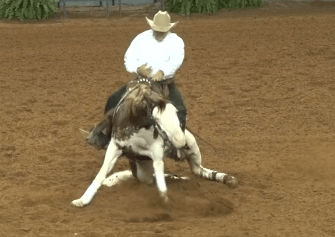

There were full-thickness skin wounds from spurs; they still hadn’t completely healed two-and-a-half months later,” says Amy Rucker, DVM, a podiatry-focused veterinarian at MidWest Equine in Columbia, Missouri. Reining trainer sued for the Tongue Split in Half
Veterinarians know trainer abuse as soon as they see it, says Amy Rucker, DVM, a podiatry-focused veterinarian at MidWest Equine, in Columbia, Missouri. She recalls a case where she came alongside a treating veterinary team to examine a laminitic horse—an exam that revealed an even more tragic tale.
The horse had cuts in the corners of his mouth as well as a large wound on each side, consistent with spur marks. “I had never seen anything like it—they were full-thickness skin wounds, and when I put the horse down two-and-a-half months later (from laminitis secondary to conditions resulting from the abuse), they still hadn’t completely healed,” says Rucker. “In my experience the abuser doesn’t directly kill the horse. The horse dies after falling while its head is ‘tied around’ or from stress-related secondary problems such as colic.”
Meanwhile, owners might be unaware of what’s transpired. “This owner was devastated by the ordeal her horse endured, not only at the trainer’s but also the prolonged medical battle,” Rucker adds. “They were heartbroken that their … horse could be a victim. Horses are nonverbal and completely dependent upon their person—a relationship similar to that between a parent and small child.”
Susi Cienciala, DVM, an equine veterinarian at Deep Creek Veterinary Services, in Enderby, British Columbia, remembers treating a reining horse whose tongue had been split in half from bit abuse. “We also had a Morgan client who wanted us to cut the tail nerves to stop the swishing,” she says. “Of course, we said no.”
But her most striking memory of abuse was when she had to remove an embedded noseband from a horse with pliers. “There was just no other way to free up that horse’s nose,” she says.
Veterinarian-confirmed training abuse can lead to legal consequences. Rucker’s client is currently involved in a lawsuit with her horse’s trainer. In 2015 reining trainer Mark Arballo was sentenced to 180 days of home detention and three years of probation after leaving a 5-year-old Quarter Horse mare, Bella Gunnabe Gifted, bitted up with long shanks in a round pen in San Diego, California. She flipped over and suffered a basilar skull fracture, requiring euthanasia. According to the civil complaint, the trainer initially whipped the mare to try to get her to stand up again, unsuccessfully. The civil case ended in a settlement for $160,000. Arballo lost his association memberships and the right to train horses during his probation period, which ended in 2018.
Why Does it Happen?
If the point is to train horses to be great mounts, why would anyone abuse them?
To achieve improved performance, mostly, say our sources. Unfortunately, there are a lot of unethical training tactics in use, says Booth, that give trainers an edge. “There’s just not a level playing field for ethical training,” he says.
Rucker agrees. “A very small percentage of horses will naturally perform at the elite level, but everyone wants to have the horse that does,” she says. “That leads to forcing them, sometimes in very unnatural ways.”
That’s especially true, she adds, for young horses being trained in a very short period to get to futurities, “where the winner receives both fame and fortune. Owners may be motivated by prize money, but trainers also pursue name-recognition for winning large competitions.”
What’s more, Rucker notes, there’s high pressure in training barns to prepare a large number of horses for shows with a limited amount of time and staff. “It’s not just a trainer problem,” she says. “It’s also an owner expectation problem. Some owners will not accept that their horse is not competing at a winning level. The trainer is pressured by the possibility of the owner moving the horse, which may have profound financial consequences after the loss of training, transport, and show fees. The horse may simply need more time to develop, or the lack of winning may be due to the owner/rider. At any rate, trainers are often pushed to come up with an immediate, low-cost solution if a horse isn’t winning.”
A complex case of conflict of interest reinforces those expectations, says Rucker. “There are too many incestuous relationships between trainers, veterinarians, owners, and judges,” she says, with roles overlapping to the extent it negatively impacts what’s considered acceptable in competition and what isn’t.
As a result, you get training tricks that might be effective, but cross the line into abuse, she says. Excessive spurring, wearing a horse out, depriving him of food and water, tying his head up, tying his head down, tying his head sideways, tying up one leg, tightening his noseband, tightening his leg boots, placing tacks or chemicals under boots, locking him in rollkur, poling with rails … the list goes on.
“A lot of people just prefer to take winning over ethical equitation,” Booth says.
Fortunately, training has evolved, say our sources, and primarily for the better. “When I first started as a vet 25 years ago, many of my clients were real horsemen, but they weren’t able to benefit from shared knowledge like they can today—mainly thanks to the internet,” Rucker says. “That’s led to a revolution in training and welfare. But not everyone’s there yet.”
Lack of education is an issue, as is a lack of understanding that people need to change what they’re doing, says Busby. “We see a lot of unconscious incompetence—meaning people don’t know that they don’t know something,” she says.
There’s also the blind faith many owners have in professionals. “People want to achieve a training result and don’t know how else to achieve it other than to hand things over to an expert, even if they have reservations about the trainer,” Busby says. “That trainer might tell the rider to beat her horse with a plumbing pole. And because the expert told her to do it, she feels like she doesn’t have the power to disagree with him, and/or she doesn’t know better.”
Uldahl agrees. “Unfortunately, there are still many examples of horses being ‘educated’ by riders (professionals and amateurs) using various types of equipment but with poor knowledge, or even people deliberately making shortcuts and thereby sacrificing horse welfare,” she says.
Reprint from TheHorse.Com
https://thehorse.com/176132/traumatic-horse-training-can-you-spot-abuse/
Further down in this article you will read the actual comments made by NRHA members and enthusiasts regarding the Professionals Code of Conduct in 2020.
You may have seen the NRHA Welfare Publicity and the Professional Code of Conduct. It reads like the horses are living in Utopia!
What the NRHA States: The Health and Welfare of our Horses
They go to say in The Professionals Code of Conduct :
Ensure that the welfare of the reining horse is paramount and that every horse shall always be treated humanely and with dignity, respect and compassion, regardless if the horse does not reside under my direct supervision.
NOW: Look inside the bubble and see what the NRHA members and reining enthusiasts really think. These comments include posts from high profile people within the reining horse business. Are the trainers held to account for their actions? Is there a standard that is enforced?

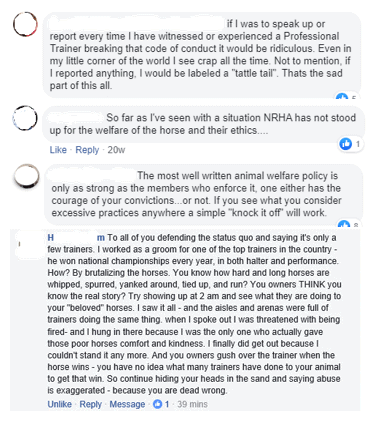
So this welfare and respect of the horse? From the 2019 Show Season

Would you want to be a member of some of those families?
Are bloodied sides and mouths, wires and spur gravel showing they are treated humanely and with dignity, respect, and compassion?
The enforcement of the Code of Ethics is managed by the trainers. Trainers governing trainers – what could possibly go wrong?
With the large sums of prize money for #runforthemillion #nrhafuturity #nrhaderby to name a few, should they be allowed govern themselves?
Questions are being asked now:
© 2020 Reiningtrainers.com. All Rights Reserved.
In an enlightened world of what is and is not acceptable in horse training methods, the Reining Horse World comes under the spotlight equally to that of the Tennessee Walking Horse – Big Lick for many people.
The fear in members is evident when you read the conversations they have regarding the welfare of horses and reporting horse abuse. The comments read of intimidation, victimization, ostracization; their real experience of reporting horse abuse.
Like the Big Lick, it is seemingly a closed shop with trainers and self-regulation being how the sport of reining is managed. They adamantly deny cruelty or abuse whilst others are shocked when they learn what goes on in the training methods. Unlike Big Lick, there are good and kind trainers within reining but there are also trainers and non-pro competitors that have no issue with their horse’s sides being blooded with spurs, mouths sored and blood, wired mouths, cut or injected tails to stop movement, drugging and numerous other atrocities occurring back at their training barns. All these things are abuse, their cruelty, (refer AAEP Guidelines on equine abuse), and certainly not how you would treat a member of the family; as NRHA marketing espouses.
When people with a consciousness toward their animals stand up, or those that see blooded sides, torn mouths, and other atrocities at shows report them, the response from those that are governing the sport, working in the office, or show pens is downright shocking.
Read from the people in the sport. Some of these people talking below are well known in the NRHA world and it includes comments from 2020.
While the NRHA spends tens of thousands of dollars of membership money creating a public persona of clean family sport, this is what is happening behind the scenes in 2019/2020.

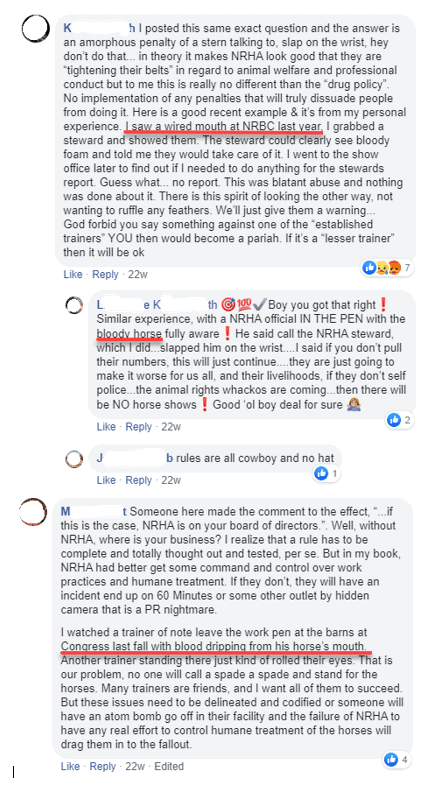
These types of conversations are endless across Reining Horse Forums.
What are your thoughts:
© 2020 Reiningtrainers.com. All Rights Reserved.
The quiet reining tail look is a signature of the reining horse, and despite the suffering to the horse, it continues. Judges reward quiet tails; even when it is clear to the public, they have been tampered with! High scoring horses with flat tails hanging like dish rags.
They are so obsessed with the look; members report yearlings presenting at NRHA sales with their tails done!
To achieve, ‘the look’ people knowingly cause harm – including hair loss, permanent nerve or muscle damage or, worst of all, amputation. With some veterinarians becoming more concerned over their reputations for tail blocking, trainers and their assistants step to needle horses’ tails with alcohol or other potions, some finding different solutions to numb the tail. Tourniquets are very popular now. Members report their horses being done without permission!
The horse’s tail serves many purposes:
With penalties for swishing tails, the motivation to stop it at all costs is high for trainers and show riders.
Horse Tail Anatomy

The tourniquets are increasing in use as they can seem harmless but if wrapped tightly achieve numbness. Quickly pulled off just before the horse enters the arena it can achieve the quiet reining tail look. BUT:
Too Much Pressure Cuts off Blood/Nerve Supply – The dock is extremely sensitive to pressure. Any wrap applied above the last vertebrae that apply prolonged pressure acts as a tourniquet, which results in loss of blood and nerve supply to the entire dock. Repeatedly wrapping too tightly or too close to the end of the tailbone can cause the whole tail to die.
Read More Articles on This Topic
where did this nrha rule proposal to stop cruelty vanish to
Outlaw tail blocking its pervasive in reining its cheating unethical land the horses suffer
© 2020 Reiningtrainers.com. All Rights Reserved.

 Are We Starting Horses Too Young? What the Science Actually SaysMarch 1, 2026 - 5:03 pm
 Why Do Reiners Have So Many Equine Drugs They Can Use?February 3, 2026 - 10:10 am
 NRHA Derby European Championships at Equitalyon 2025January 26, 2026 - 8:11 pm
 One in Ten Reiners Test Positive For Prohibited SubstancesDecember 28, 2025 - 10:14 pm
 A Reiner is a Robot – When Obedience Replaces Horsemanship?November 10, 2025 - 7:07 pm
 The Physical Demand on Reining Horse’s When SlidingNovember 4, 2025 - 10:41 pm
 Spinning The Reining HorseOctober 15, 2025 - 10:30 pm