Explore key welfare issues in reining horses, including training stress, physical strain, drug use concerns, and industry calls for more ethical horsemanship.

Who is protecting the reining horse’s welfare?

“Unfortunately we do have our share of abusive trainers in our industry that I consider a minority, and when identified, they should be removed, period. It is these individuals that attach a bad stigma to the industry” says Rick Dennis of Wind River in May 2015. A highly respected quarter horse performance breeder and competitor and author of many articles on horse abuse.

You do not need to look too far to find examples of extreme reining horse abuse. In 2013 reining horse trainer Kyle Ronald Weston, from Alberta, CA was charged with horse abuse. The photo on this page is the result of his excessive spurring of a horse at home in his barn. The mare’s mouth was reported to also bleeding badly.  The NRHA did not take any action against him until after he was charged by the law courts.

There are extremists everywhere in both the level of abuse and the animal rights advocates who don’t even want horses ridden. In the middle ground of treating a horse respectfully, there is a place for sound and logical welfare of the horses. Would you do it to a child? Then you should not be doing it to an animal as a constant measure. The oversight of horse abuse should not just be in the show arenas and warm-up pens, but back home at the barns. That is where most of the abuse actually occurs and where people have the most direct experience with reining trainers.

For their welfare, a middle ground must be struck where horsemen from other disciplines can evaluate and define what is reasonable, not just people that are indoctrinated into a way of thinking like the culture of the reining horse industry.

The problem is that the public, newcomers, and members are wooed by the photos of expensive barns with extensive breeding and training facilities and horses presented like rock stars. The glitz of the show entertainment, expensive advertising campaigns and the lure of big prize money. This glamourous image is a far cry from how most horses live and are trained by hundreds of people across the world proclaiming themselves as reining horse trainers. Behind this glamour are many tales of the physical and mental abuse of horses. It is not just limited to the horse under saddle, but how they are treated in their day to day lives. What happens away from the spotlight and public eye and seen only by people investing in having horses trained, whether they are NRHA members or not.

The truth of what happens can be seen with horses like trainers Weston’s and Arballo.
bella-wider-shot

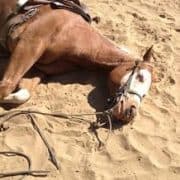
Reining horse trainer Mark Arballo, a repeat offender of being charged for horse abuse, in 2015 was charged again over the horrific death of Bella. Again, with full awareness of the matter, the NRHA is reported to have not taken any action against this person until after he was charged by the law courts.


The shocking attack at the major show, Reining by the Bay, in 2015 where three of Andrea Frappani’s horses were poisoned, and one had a U-Shape nail driven into his foot.staple-in-foot Horses at the top of the game were targeted by someone who was most likely more motivated to win than care for the well-being of horses. A person that was either personally motivated or paid to commit extreme acts of cruelty against those innocent horses; evidencing a potentially highly competitive ‘at all costs’ culture within reining.


For many people reporting horse abuse can mean the end of their involvement in an association.

An association they have invested heavily in, both in money and emotion. The few that stand up for the horses are quickly finding there are few avenues for complaints that are not met with criticism and denigration by trainers and their friends. Some complaints are pushed toward the courts as the only option, where outcomes of such matters are reported to be unlikely to succeed due to the lack of knowledge and priority of animal abuse in the court system. Weston’s case gives measures of extreme abuse and getting just a $4,000 fine.

For a complainant, trainers are often victimizing the person for speaking out as they see the person as turning in one of their own. Many trainers are quickly justifying their actions by saying the person knows nothing and vilifying the person by relying on the cult-like behavior of their followers to support them. You will see many social media posts where they victimize the person who dares to stand up for the horse’s welfare.

Unfortunately and very real is the fact that many people reluctantly condone the abuse, by remaining silent, as the fear of being ostracized for speaking out against someone is more penetrating on them personally than living with the knowledge of a horse suffering out of sight. They attempt to reconcile the abuse by closing their minds or moving to another trainer. They fear becoming a victim of social media keyboard warriors as uninformed, often very ignorant and closed-minded people make wild and often threatening statements against the abused reporter. People quickly protect the abuser due to their public persona and their desire to stay in the group, with little to no regard for the horse. The more the celebrity status of the trainer, the more likely this will occur.

Could all of that really happen to someone reporting horse abuse? Sure, it could, and it does and anyone active on social media will most likely have seen it first-hand.

People are reaching out to Reiningtrainers.com, sending shocking stories of horse abuse and how they became victims for attempting to help the animal. Some have just walked away from the reining industry, and others have paid the price for speaking out and being pushed out. Moreover, an appalling outcome is the people that are attempting to live with the knowledge they let the horse (and more in the same barn) down by not speaking out.

However, what would happen if you all would send a loud and clear message to the reining horse industry that you will not tolerate horse abuse at any cost?

Consider the famous quote of Albert Einstein, who once said,

“The world will not be destroyed by those who do evil, but by those who watch them without doing anything.” Think about it and reflect on the horses.

It is the responsibility of the National Reining Horse Association and its affiliates to provide the tools and mechanisms to permanently weed out the abusive trainers and give members and the reining horse enthusiast public the confidence to report their concerns. Set a standard by removing peer reviews of complaints where subjectivity is rife and, agendas can be at play. Install independence to ensure complaints receive the balanced hearing they deserve. A place where the horse becomes the priority and actions are taken to filter out those that are abusing the animals and setting an underlying standard of acceptance in the market.

What do you think?

Are you concerned over a reining horse’s welfare  – send us the details via our contact page.

Please vote for Change on our Poll – the poll is now closed.

© 2016 reiningtrainers.com  All rights reserved.
Does self-regulation of animal welfare and abuse work?

Many associations, like the National Reining Horse Association (NRHA), take an approach to managing animal welfare and abuse through self-regulation by trainers and the case study of the Tennessee Walking Horse tells everyone, that it fails. Watch the video on this page and you will be shocked at the suffering they inflict on horses and justify as training methods.

soring- animal welfare and abuse issues

Appalling treatment of a horse burning its legs to create false high stepping.

Over the past half-century, the treatment of the Tennessee walking horse has increasingly become more inhumane as they attempt to achieve higher stepping horses known as the ‘big lick’. The trainers and owners have reached a point where now, these poor animals endure vile practices in which caustic chemicals, chains, hard objects, cutting, and other gruesome techniques are used to injure the horses’ front legs and hooves and force them to perform an artificially high-stepping gait known as the “big lick.” This sort of calculated, appalling cruelty should never be tolerated. The trainers self-regulate and the outcome is horrendous.

Like the NRHA, the Tennessee walking horse has a welfare statement within its rules, but that has certainly not protected these beautiful animals from barbaric treatment easily identified on horses attending a competition.

In competition, trainers are looking for that winning edge and across all disciplines you see people stretch the boundaries of welfare with the desire to win; some becoming animal abusers as they justify their actions to themselves. The horse is no longer a priority as winning has become their image, their livelihood and there is always another horse waiting to enter the barn.

In reining warm-up pens across the globe, you can watch trainers as they push the boundaries and subject the horses to unnecessary pressure and pain in preparation for that moment of winning. Often sanctioned by others around them and creating a benchmark for other trainers also to push their horses to the limits at all cost to the animal. With medical evidence of the damage being caused by some practices, the trainers are defiant and attempt counterarguments against scientific facts.

Owners may lack the knowledge, and some the heart, to understand the pain and suffering of their horse as they buy into the story promoted by the trainer as ‘how things are done to train show horses.’ The trainer, a perceived expert, uses their position of influence on the owners to their own gain in justifying their conduct. Trainers, farriers and owners are indoctrinated into the idea that those is how you must treat the animal to achieve a high-level competition horse.

Is reining heading in the direction of the Tennessee walking horse?

Are the boundaries now being pushed with the increasing rise of excessive spurring, jerking of reins, more aggressive bits and rollkur increase in the show pen? The wastage of reining horses increases as animals are quickly thrown aside that will not submit to the excessive demands of the trainer’s techniques. The videos of the European FEI and just recently a video taken in the US demonstrates that it is becoming more epidemic and accepted.

For the Tennessee walking horse, mainstream horse industry groups and veterinary organizations such as the American Horse Council, American Association of Equine Practitioners, and American Veterinary Medical Association have

tried to work with and encourage the walking horse crowd to bring about change from within – but more than a few stubborn horse owners and trainers continue to think they are above the law.

The US lawmakers now state the current system of self-regulation is still hopelessly broken, and nothing short of significant reforms will fulfill the intent of Congress and break the cycle of cruelty that is so endemic to the big lick walking horse circuit.

With the awareness of the Tennessee walking horse’s plight and how they got there, is the NRHA going to move from self-regulation to a system of transparency and improvement that ensures the reining horse does not follow in their path?

What actions are considered horse abuse? Click here to find out more.

Have some news or video of reining horse abuse? We are building a case for reform on trainers and your contribution can assist. Click here to send us information.

Sound familiar – the reining horse is bred for his natural athleticism and shown willingly guided:

The Tennessee walking horse is bred for its smooth, natural gait—the running walk—and The HSUS supports the many owners and trainers who use humane training methods to showcase this natural gait, while also working to end the abusive practices often used to create the exaggerated high-stepping gait that has long been associated with soring. 

Listen to a convicted Horse Abuser on the horrific practices he and others apply to horses. This is not protecting animal welfare and abuse is Riff!


Martin Muehlstaetter demonstrates he can abuse a horse

At the FEI World Reining final warm-up, Martin Muehlstaetter took to this horse in full public viewing with his spurring, sawing and gouging like a possessed man. The excitement of a major show, the overwhelming desire to win at all costs, sees the horse suffer to a level that should have demanded his immediate dismounting of the animal and removal from the show. Cleary unable to rationalize right from wrong, this man now travels the world giving clinics on reining horse training and is upheld by the NRHA as one of the Top 20 Trainers in the world.

Is this what it takes to train a Reiner or is this a person that is incapable of controlling his emotions? Is this an association that condones horse abuse to keep the entertainment rolling and trainers flowing the cash through their tills?

It would seem that at these FEI world championships the world became aware of the horse abuse that has been occurring hidden away in niche show pens and barns for many a long year.

What actions are considered horse abuse? Click here to find out more.

Have some news or video of reining horse abuse? We are building a case for reform on trainers and your contribution can assist. Click here to send us information.

To read more about their warm-up pen performance, Read the Book “I Can’t Watch This Anymore” with first-hand accounts of what happened to the reining horses.


Nico Hörmann matches the US in horse abuse methods

Not to be outdone by his American competitors, Nico Hörmann demonstrates his talent in gaining total submission during the warm-up of the FEI World Reining Final Warm-up. In relentless style, this man abuses this horse under the guise of professional training talent and a standard that is accepted industry-wide. Working amidst the other horses it seems to be an accepted practice that you cannot achieve ‘willing guided’ without excessive spurring, sawing of mouths, and full-strength jerking of reins in a spoon or port bit. The horse must give in and be dictated to as if it is a robot there to serve the whim of the rider. Clearly, the interpretation of willing guided has shifted from graceful to absolute submission; a sad fact for the horse.

Top competition and huge prize money are seeing massive changes in how reining horse is being trained as trainers and owners demand faster results and look for shortcuts, and it’s only getting worse. Review the video from 2016 that shows a warm-up pen that you would see at any weekend show or major event.

What actions are considered horse abuse? Click here to find out more.

Have some news or video of reining horse abuse? We are building a case for reform on trainers and your contribution can assist. Click here to send us information.

Behind the Scenes of Reining Horse Fencing

Reining Horse Fencing

Have you ever wondered how they train horses to get that big sliding stop? Simple – run it flat out at a wall and if it hits it, that is okay.  That is called Reining Horse Fencing. This video shows reining trainers working their horses to build a stop on their horses. At some point in time, someone many years ago, decided that running into walls was a good idea. I remember seeing this for the first time at a futurity warm-up pen with a top trainer running his horse at a wall. The horse finally decided what he wanted and ran into the wall headfirst with his butt buried in the ground. The trainer patted him and sent the message ‘that’s it – hit the wall’. Now in any warm-up pen or at home on the ranch trainers use this technique.

Applying logic to the method would only get in the way of what is clearly a ridiculous training technique that is suffered by these magnificent animals. Only a reining horse would have the mind and lack of fight in it to accept this continuous training and become a submissive and robotic animal willing to do anything to avoid further abuse; no matter how much pain it suffers.

What actions are considered horse abuse? Click here to find out more.

Have some news or video of reining horse abuse? We are building a case for reform on trainers and your contribution can assist. Click here to send us information.